
Employment Rights Act 2025 and probation periods: Should employers reduce six months to three?
Author
Cassie Briffa
Published
Share this article
Many employers are reviewing probation periods because of the Employment Rights Act 2025 and the move towards earlier unfair dismissal protection. But reducing probation from six months to three months is only part of the picture.
From 1 January 2027, employees are expected to qualify for ordinary unfair dismissal protection after six months' service, rather than two years.
That makes the early months of employment much more significant for employers.
One of the questions I've been asked most is:
Should we reduce our probation period from six months to three months?
A six-month probation period, combined with a contractual notice period, could mean an employee acquires unfair dismissal rights before their employment actually ends. That's a genuine consideration, and every employer should be reviewing their probation arrangements to make sure they're still fit for purpose.
But after having this conversation with business owners and managers time and time again, I keep coming back to one thought.
I think we're asking the wrong question.
Rather than asking whether probation should be three months or six, perhaps we should be asking whether our probation process is fit for purpose.
Why are employers reviewing probation periods?
The Employment Rights Act 2025 has prompted organisations across the UK to review their contracts, policies and recruitment processes.
Probation periods have naturally become part of that conversation.
For some employers, reducing probation from six months to three months feels like the safest option. It reduces the risk of an employee reaching unfair dismissal protection before a decision has been made.
I understand that thinking.
But changing the number alone doesn't improve the quality of the process behind it.
If shortening probation is your only response to the Employment Rights Act 2025, you've reduced one legal risk.
You haven't necessarily improved the way you recruit, support or manage new employees.
In my experience, probation has never been about the length
Throughout my career, both working in-house and now as an HR Consultant at Cornerstone Resources, I've seen organisations with three-month probation periods manage them badly, and others with six-month probation periods manage them exceptionally well.
The difference has never been the number of months.
It's always been the quality of the management behind them.
I've seen employees fail probation despite never being told there was a problem.
I've seen managers avoid difficult conversations until the final week because they hoped things would improve.
I've also seen businesses transform new starters into fantastic employees because expectations were clear, support was available and conversations happened regularly.
Those experiences have shaped the way I think about probation.
Recruitment is one of the biggest investments a business makes
Think about everything you've already invested before a new employee even starts:
You've advertised the role.
Reviewed applications.
Interviewed candidates.
Completed pre-employment checks.
Issued contracts.
Delivered an induction.
Provided training.
Allocated management time.
Supported them through those all-important first weeks.
Why would you make that investment only to spend the next few months waiting to see whether someone fails?
For me, probation should never be a countdown to dismissal.
It should be one of the most valuable stages of the employee journey.
It's where expectations are set.
Confidence is built.
Skills are developed.
Feedback becomes a habit.
Problems are identified early.
Success is recognised.
And if someone ultimately isn't the right fit, there should be no surprises for either party.
What does a good probation process look like?
One of the things I value most about working at Cornerstone Resources is that we've never viewed probation as simply a date in the diary.
Long before the Employment Rights Act 2025 changes, we were helping clients build probation processes that were structured, supportive and fair.
When we developed our probation framework, we didn't start by asking whether probation should last three months or six.
We started by asking a different question.
How do we help managers get the very best out of new employees while making fair, evidence-based decisions?
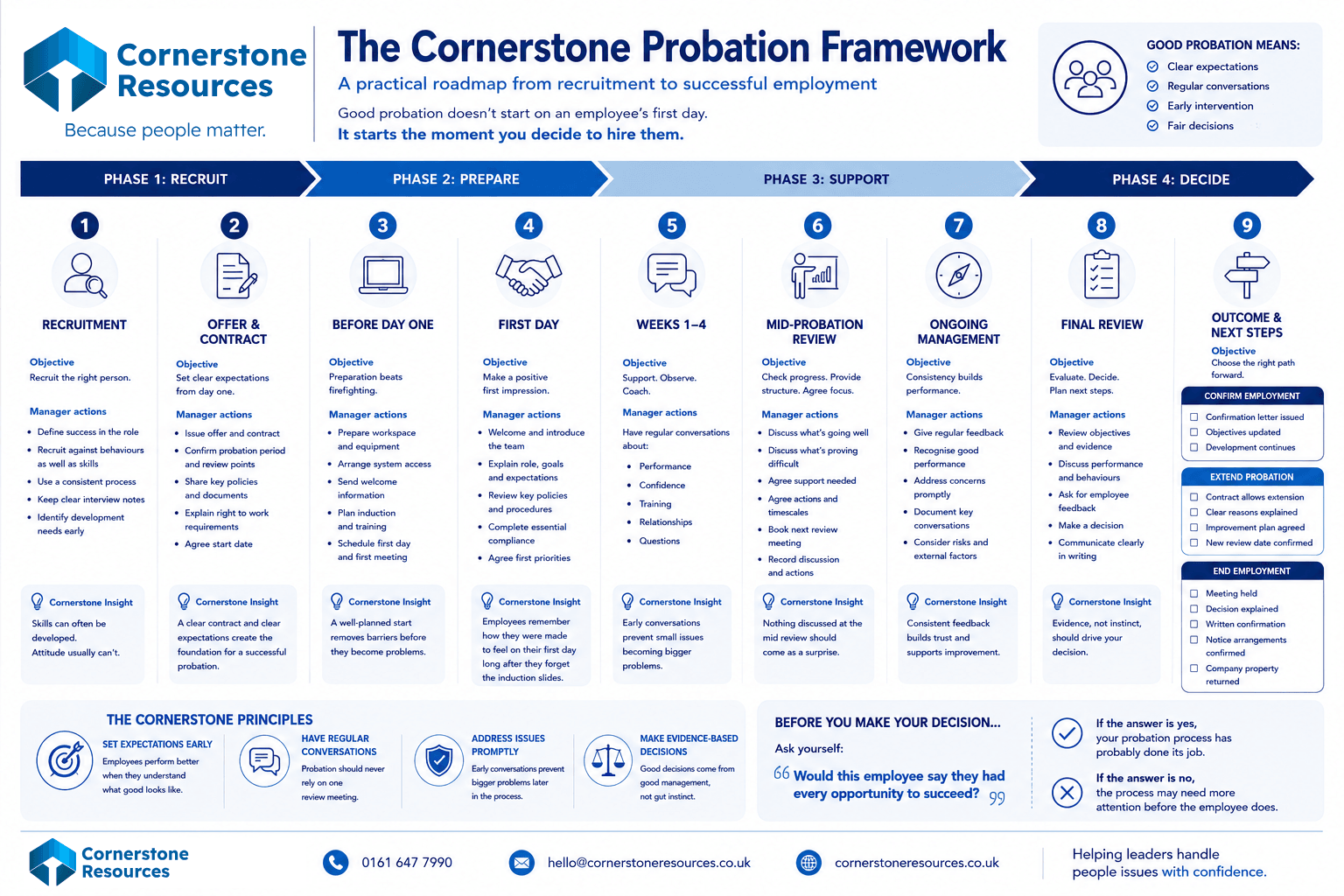
For us, that means:
- Planning probation before the employee starts.
- Setting clear expectations from day one.
- Scheduling review meetings in advance.
- Holding regular, meaningful conversations.
- Giving honest and constructive feedback.
- Providing support where it's needed.
- Addressing concerns early rather than waiting until the end.
- Recording progress and agreed actions.
- Factoring notice periods and key decision dates into the timeline, so decisions aren't left until the last minute.
The Employment Rights Act 2025 hasn't changed those principles.
If anything, it's reinforced why they've always mattered.
Should you reduce probation from six months to three months?
Maybe.
For some organisations, three months will be the right approach.
For others, six months will still be appropriate.
There isn't a one-size-fits-all answer.
The important thing is that your decision is based on what's right for your business, your people and your recruitment process, rather than simply what feels like the safest legal option.
Whatever length you choose, don't let the conversation stop there.
Review the whole process.
That means looking carefully at how probation is managed in practice, including whether managers are confident, expectations are clear, review meetings happen at the right time, concerns are addressed early, and decisions are properly recorded.
Before you change your probation period...
If you're reviewing your probation arrangements because of the Employment Rights Act 2025, don't just ask whether you should move from six months to three.
Ask whether your current process is clear, consistent and well documented enough to stand up to scrutiny.
Review the process before you change the timescale.
Before making changes to your probation period, it is worth taking a step back and looking at how the process currently works in practice.
If you are not sure whether your current approach is fair, consistent or well documented, that is usually a sign that the process needs a proper review.
Check out our recommended probation process split into four clear phases in this image. Why not print it out and stick it on your wall for reference!
Need help reviewing your probation process?
At Cornerstone Resources, we help employers review their probation arrangements, so they are practical, fair and aligned with upcoming employment law changes.
That review can look at the length of your probation period, your contractual notice provisions, how managers are using probation meetings, and whether decisions are being made and recorded in a fair and evidence-based way.
Rather than simply reducing probation from six months to three, we can help you understand whether your current process is genuinely fit for purpose.
Contact Cornerstone Resources to arrange a review of your probation process and make sure it is working in practice, not just on paper.
If you are reviewing probation periods in light of the Employment Rights Act 2025, speak to us before making changes. We would much rather help you build a process that works than help you defend one that does not.
Related articles
Zero-hours and low-hours contracts: What might be changing?
The Government is consulting on new zero-hours contract rules. Find out what's proposed, what it means for employers and how to prepare for changes.
Trade union law changes: A manager’s no‑panic guide
What managers need to know about the changes around trade unions: what’s changing, when it’s changing and what you actually need to do.